Presentation given to the Iowa Association of School Boards Fiscal Management Workshop. Parts of the presentation used with permission from Evelyn McCormack.
Links:
Waukee School District Considers Social Media Policy
Cedar Rapids CSD Board Reviews Social Media Policy
Illinois Association of School Boards Journal - Social Media can Offer a Different Conversation
Ohio School Board Association - Leaping into Social Media
National School Board Association - Tagged Articles on Social Media
Edutopia - How to Create Social Media Guidelines at Your School
School Communications 2.0
Evelyn McCormack - Valuable Social Media Resources

Wednesday, July 18, 2012


Tuesday, June 19, 2012
Blended Learning in Your Classroom
Presented to TICL (Northwest AEA and Prairie Lakes AEA) conference, 6/19.
Links of note in the presentation:
• Resource Iowa (Statewide Moodle Site)
• Moodle Resources
• Curriki
• Connexions
• Merlot
• CK-12
• Hippocampus
• MovieClips
• Udemy
• Khan Academy
• Diigo
• Geogebra
• Edmodo
• Google Docs
• ITSI-SU
• Youtube video of Aaron Sams
• OLLIE courses
Links of note in the presentation:
• Resource Iowa (Statewide Moodle Site)
• Moodle Resources
• Curriki
• Connexions
• Merlot
• CK-12
• Hippocampus
• MovieClips
• Udemy
• Khan Academy
• Diigo
• Geogebra
• Edmodo
• Google Docs
• ITSI-SU
• Youtube video of Aaron Sams
• OLLIE courses
Tuesday, October 18, 2011
AEA PD Online - October Update

This summer, we offered 72 online courses (with 1109 participants). That has been with limited number of instructors, as we are currently in a recruiting effort for more instructors to meet demands (those interested can start at our instructor toolbox or contact me). We should be at about 50 courses offered this fall. Our goal for 2012 is to offer 300 online courses.
Our online training system underwent many changes this summer as well. We added several Medication Administration trainings in specific areas:
- Administering Rectal Diazepam for Seizures
- Nebulizer Treatments at School
- Administering Glucagon to Students with Diabetes
- Medication Administration by Gastrostomy Tube
- Insulin Pumps
- Giving Insulin Injections
With these changes, and the recent $20 million cuts to AEAs, the AEA Chief Administrators have determined AEA PD Online will need to be self-sufficient. To assure self-sufficiency, there is a new funding structure in place for the online trainings. Individual participants now need to pay a $25 fee to complete the Mandatory Reporter training, a condition of licensure in Iowa. Also, districts have a 50 cent per enrolled K-12 student fee for unlimited access to all the other trainings on the system. Money raised from these ventures will help our instructional design support. Our plans are to add 5-10 new trainings this year with our instructional design support, for no additional fee to districts.
AEA PD Online's operational council approved the following goals for 2011-12:
- Expand and diversify our current offerings
- Implement quality assurance procedures
- Determine and foster relationship to other groups and initiatives in Iowa
- Continue implementing systemic plan of marketing and communication
- Assure funding self-sufficiency
More to follow, including the implementation of a mentoring program and a study of online communities in the state of Iowa.
Sunday, October 16, 2011
Metamorphosis of OLLIE 2
I am currently taking a post-midnight break from grading students in my OLLIE course "Technology for Online Instruction" (hoping to have that all finished still tonight). As I think about the two ITEC presentations that I still have not begun (giving those in 36 hours), a thought has come to me. It is interesting to take a look at how this course has changed over time.
The Technology for Online Instruction course introduces students to online tools, with a primary focus on Moodle. Participants each have a "practice course" where they have to create on their own the basic attributes of Moodle (a forum, a webpage, a lesson, a quiz, etc.)
Despite being the second course in the OLLIE sequence, I developed it first, withing the first few months I began to work for Heartland AEA (fall of 2008). I didn't know what I was doing at the time... not that I'm much better than that now. But at least I've tried a variety of things to improve the course over time. Indeed, the current iteration is the 9th different time I've offered the course since then, and each time takes on a bit of a change.

Well, it served the purpose. We had a course up and running, my first one ever in Moodle, and with live students to work with, I figured out pretty quickly we needed to make some changes.
ATTEMPT #2:
While the next time I offered the course I still was focused on simply learning Moodle, I made several changes to the content.
• Concise Was Better. I had way too many resources, resulting in the scroll of death, as you can see. I took large numbers of Moodle Webpages I had created and wove them together into a single Moodle Lesson. The result was a leaner look that was less panic-inducing for students and made their work more direct.

• Simplify My Assignments. Not only did I have too many resources, I had too many assignments. Actually, I had way too many forums; I had 11 in the first go-round. All students were doing was creating forum posts to topics, and not all the questions had a lot of bearing on their understanding of Moodle. I eliminated half the forums right off the bat.
• Eliminated Downloads. My first try featured a few Word documents and several PDFs. Which, required the user to have to download and view those outside of the browser. I never ran into the hypothetical student who did not have MS Word, so I was lucky. But transferring those into Moodle webpages and lessons made the content all self-contained in the course.
My 3rd attempt was primarily aimed at incorporating another tool, Adobe Connect Pro, into the course. We were actively pushing that as an AEA. However, while I was able to work it in to the curriculum, it always felt like a poor fit, and I ended up minimizing it after the 4th attempt.
ATTEMPT #4
My 4th attempt featured quite a bit of change, as I was now getting better at the concept of instructional design. I was now teaching 3 other courses online, so I was picking up several tips that I hadn't realized before.
• Embedded Video. I removed almost all of my uploaded video from the course. Instead, I embedded the video, either from YouTube or AEA's Eduvision. This has saved tremendously on bandwidth and the speed by which participants can access the videos.
• FAQ Database. I had made archived backups of all the previous courses before resetting them. This was a wise move, as I still had access to all the past Question & Troubleshooting forum questions that students had posed. I took all of the questions as well as the answers I provided and I put them into an FAQ database. The number of student questions in course #4 went down by 90%. And while I don't have as many questions, I still add them after every new course.
• Multiple Learning Paths. The biggest change to the course was out of necessity. I had several individuals struggle with learning Moodle, becoming overwhelmed by the added item of building their own content. For this course, I add the "template course" option. Specifically, I created my own template course - Basketball 101. I also recorded myself making each of the steps. For those participants who needed a more guided approach to learning Moodle, they could now re-create the template course, basically copying and pasting all the text (and using all the same images). In this way, they wouldn't have to take up time developing their own text. They could also follow my recordings step-by-step. And, they had a finished model to work with, to compare to their own product. This was a giant game-changer to the course, and all of the future courses I have developed have used a similar "multiple learning paths" model.
• Soft Chalk. I finally had had enough of Moodle's lesson module, as it looked boring and was clunky to navigate. I had access to Soft Chalk's "Lesson Builder" program, which is now known simply as Soft Chalk. Taking the lessons that I had created in Moodle, as well as a few brand new lessons (like how to embed Google Forms into Moodle), I created a Soft Chalk lesson for them and replaced the old one. Some might consider this a minor detail (it is just window dressing, right?). And yet, when individuals were creating their own practice courses, they wanted to know how I had made the lessons with the neat banners and built-in navigational items. And especially the hands-on interactives that Soft Chalk allows you to embed within it. Being SCORM-compliant, adding Soft Chalk was extremely easy to do, and greatly enhanced the visual professionalism of the course.

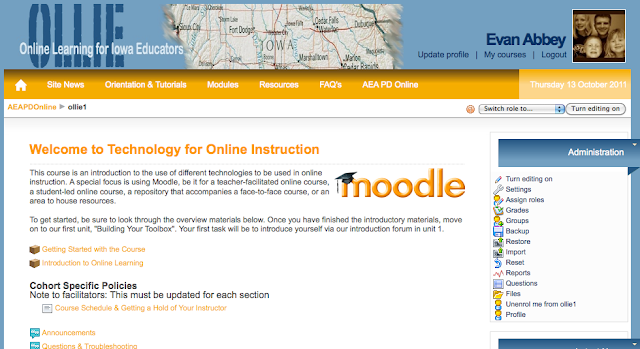

The Technology for Online Instruction course introduces students to online tools, with a primary focus on Moodle. Participants each have a "practice course" where they have to create on their own the basic attributes of Moodle (a forum, a webpage, a lesson, a quiz, etc.)
Despite being the second course in the OLLIE sequence, I developed it first, withing the first few months I began to work for Heartland AEA (fall of 2008). I didn't know what I was doing at the time... not that I'm much better than that now. But at least I've tried a variety of things to improve the course over time. Indeed, the current iteration is the 9th different time I've offered the course since then, and each time takes on a bit of a change.
THE BEGINNING:
When I first set out, the main purpose was to learn Moodle. Actually, that was the sole purpose. I was in a hurry to get a course out to meet the growing demand, so I grabbed a bunch of free misfit resources off the web and threw it together. The result:
Well, it served the purpose. We had a course up and running, my first one ever in Moodle, and with live students to work with, I figured out pretty quickly we needed to make some changes.
ATTEMPT #2:
While the next time I offered the course I still was focused on simply learning Moodle, I made several changes to the content.
• Concise Was Better. I had way too many resources, resulting in the scroll of death, as you can see. I took large numbers of Moodle Webpages I had created and wove them together into a single Moodle Lesson. The result was a leaner look that was less panic-inducing for students and made their work more direct.

• Eliminated Downloads. My first try featured a few Word documents and several PDFs. Which, required the user to have to download and view those outside of the browser. I never ran into the hypothetical student who did not have MS Word, so I was lucky. But transferring those into Moodle webpages and lessons made the content all self-contained in the course.
My 3rd attempt was primarily aimed at incorporating another tool, Adobe Connect Pro, into the course. We were actively pushing that as an AEA. However, while I was able to work it in to the curriculum, it always felt like a poor fit, and I ended up minimizing it after the 4th attempt.
ATTEMPT #4
My 4th attempt featured quite a bit of change, as I was now getting better at the concept of instructional design. I was now teaching 3 other courses online, so I was picking up several tips that I hadn't realized before.
• Embedded Video. I removed almost all of my uploaded video from the course. Instead, I embedded the video, either from YouTube or AEA's Eduvision. This has saved tremendously on bandwidth and the speed by which participants can access the videos.
• FAQ Database. I had made archived backups of all the previous courses before resetting them. This was a wise move, as I still had access to all the past Question & Troubleshooting forum questions that students had posed. I took all of the questions as well as the answers I provided and I put them into an FAQ database. The number of student questions in course #4 went down by 90%. And while I don't have as many questions, I still add them after every new course.
• Multiple Learning Paths. The biggest change to the course was out of necessity. I had several individuals struggle with learning Moodle, becoming overwhelmed by the added item of building their own content. For this course, I add the "template course" option. Specifically, I created my own template course - Basketball 101. I also recorded myself making each of the steps. For those participants who needed a more guided approach to learning Moodle, they could now re-create the template course, basically copying and pasting all the text (and using all the same images). In this way, they wouldn't have to take up time developing their own text. They could also follow my recordings step-by-step. And, they had a finished model to work with, to compare to their own product. This was a giant game-changer to the course, and all of the future courses I have developed have used a similar "multiple learning paths" model.
• Soft Chalk. I finally had had enough of Moodle's lesson module, as it looked boring and was clunky to navigate. I had access to Soft Chalk's "Lesson Builder" program, which is now known simply as Soft Chalk. Taking the lessons that I had created in Moodle, as well as a few brand new lessons (like how to embed Google Forms into Moodle), I created a Soft Chalk lesson for them and replaced the old one. Some might consider this a minor detail (it is just window dressing, right?). And yet, when individuals were creating their own practice courses, they wanted to know how I had made the lessons with the neat banners and built-in navigational items. And especially the hands-on interactives that Soft Chalk allows you to embed within it. Being SCORM-compliant, adding Soft Chalk was extremely easy to do, and greatly enhanced the visual professionalism of the course.

GENESIS OF OLLIE
It was at this time, the spring of 2010, that we began to conceptualize a new way of providing professional development for online teaching. We were putting down the foundation for AEA PD Online, and were looking for instructors. In addition, the Iowa EdTech ARRA grant started, and we had 20 schools across Iowa sign-up to have their teachers trained. We branded a more comprehensive initiative as OLLIE (Online Learning for Iowa Educators), a sequence of 5 courses (to be built over the next year), and built off the Iowa Online Teaching Standards. This meant several changes for our course.
It was at this time, the spring of 2010, that we began to conceptualize a new way of providing professional development for online teaching. We were putting down the foundation for AEA PD Online, and were looking for instructors. In addition, the Iowa EdTech ARRA grant started, and we had 20 schools across Iowa sign-up to have their teachers trained. We branded a more comprehensive initiative as OLLIE (Online Learning for Iowa Educators), a sequence of 5 courses (to be built over the next year), and built off the Iowa Online Teaching Standards. This meant several changes for our course.
• Re-branding. This is similar to what many other virtual schools have gone through, where a course that was locally developed and used by a teacher was now being assimilated into something bigger. We customized our own template on our new statewide Moodle server, using the Aardvark theme.

• Adding Images. This didn't happen solely in this step, but by this time, it was very noticeable. There were now images to break up long sections of text, as well as visual elements like horizontal rules.
• Change in Focus. Since this course was now part of an online pedagogy sequence, the focus was placed on understanding the concept of online technology as a whole. Some items of Moodle were moved to the enrichment section in order for participants to explore the other online tools that can be utilized within the framework. For the first time, participants now examined a brief summary of the different categories of tools that are available for online instructors, and then chose on their own an independent proposal to examine one tool. This, they then incorporated into their work.
• Groups & Groupings. This was also the beginning of the gargantuan sections of OLLIE, which we've called the Cohorts. Cohort 1 had 93 participants in it (we are currently on Cohort 5, which has 86 participants). These large groups were due primarily to the demand and the lack of supply... I was the only teacher at this point. Having 93 classmates will kill a participant, so I reconceptualized the course using groups of 15-20 people to make up a "class". I then made the activities in the course accessible by group, so that they would only see their fellow classmates. For me, since the course already used a small group assignment, this required some personal learning... I had to figure out groupings during the middle of the course, as I inadvertently set up the course wrong. Luckily, I won't make that mistake again.
REVISIONS OVER THE LAST YEAR
The course continues to evolve, despite that familiarity that sinks in when you have taught it repeatedly. I gave up the other courses that I had taught online, and only teach the 5 OLLIE courses, so that helps a bit in focus.
• Diigo. When I began to develop the other OLLIE courses, I was set on doing a mixture of group work activities. Forums were great to a point, but they weren't always the form of interaction that I wanted. While I had used Diigo for years and had even referenced it in the course as a tool online instructors could use, it took me quite a few iterations before I finally took my own advice. I changed our "Online Teaching Standards" forum into an "Online Teaching Standards" Diigo collaboration, which had the added benefit of familiarizing participants with another form of technology. This hasn't always been smooth, even when I had participants do their collaboration only in a Diigo group we formed. When the next section of the course came to the same website, they weren't greeted with a blank slate to Diigo-annotate (and after one class of 93 participants, there isn't much to annotate anymore). I had to seek out permission from the authors to make a copy of their articles to use in the course, and then make a fresh new copy with each new section of the course that I teach.
• Adobe Captivate. My recorded screencasts of me building different Moodle features had served their purpose, but it was time for a better tutorial. I re-recorded them, this time with Adobe Captivate. This allowed me to pause in between steps and annotate with words and arrows to show what I was talking about.

LOOKING TO THE FUTURE
Right now, we are still in the middle of changes. This past summer, we began to have different instructors teach the course. This has brought on a whole new set of challenges, which I'm probably a few iterations away from mastering. For one, the course still references a lot of outside resources. Those links go bad or those video clips suddenly disable embedding. And whereas before I only needed to keep track of my own course, now I need to make changes in many courses.
We are looking at Moodle's built-in repository feature. This essentially allows you to keep one copy of the resource on the server, and then each section of the course links to the central repository instead of its own file structure. Looks promising, yet we still have lots of work to do to get it to work.
That's not the only new feature that's out there. We are looking to integrate Google Apps into the Moodle platform, so that when a person signs in, their Google Apps (mail, calendar, docs) all appear within the course. This will allow for streamless use by our instructors over time. But this requires curriculum changes, assessment changes in the course, and new tutorials/resources. Similarly, we have added a audio recording tool that is embedded within the Moodle platform, which will be nice once we have it utilized.
The content itself is ever-changing as well. Podcasting was a big deal when I created this course. Now no one selects it as their independent proposal. Nings have gone away, as have dozens of other tools. Keeping the links active and the content fresh is a non-stop job.
The point here being, it is a misconception to think once you have built a course, it will never change. If it doesn't change, it isn't a course that I'd like to take. As an instructor, you have to have this in mind when you make the choice to teach online.
Wednesday, September 21, 2011
No Imagineering Allowed

But today is different. I'm blogging with a bit of anger. Never a good thing.
My oldest daughter entered 6th grade this year, meaning middle school. She is taking on a lot, including Pre-Algebra, Confirmation, and her first job (teaching Tae Kwon Do for Park and Rec). Her busyness has caused a lot of stress for her, which usually results in some deep discussions and a few tears.
So imagine my frustration when the latest issue was because a teacher wouldn't let her be an imagineer.
Okay, background info. Imagineer = the artistic brains behind designing Disney World attractions and rides. And the assignment = your run-of-the-mill "pick an occupation that you want to be and copy down facts about it... er, research it".
This assignment of course will be done a dozen times by a student in their school career, probably starting in kindergarten. Perhaps more, now that we are paying lip service to "employability skills" usually without any comprehensive curricula on fostering them. I should say, some teachers do this assignment better than others. Better than this case, for example.
The issues were two-fold. One, they were only allowed to pick occupations from a book (a "30-year-old" book, my daughter informs me). Yeah, nothing screams 21st century education like picking antiquated occupations. And two, they were only allowed to research from that book. Which isn't research. You should be banned from ever being able to use the word "research" if this is your idea of it. One source? No synthesizing info from a variety of sources? No evaluation of whether the source is valid or important? Just simply copying stuff down?
So my daughter, the mercurial one that great teachers will love and average teachers will hate, asks why she can't do Imagineering. Answer = 'cause its not in the book.
What's lost on me, and it may show my disconnect from other forms of teaching, is if I were a teacher doing this assignment, I would absolutely love for someone to come up with this. Sure, it might be as pie-in-the-sky as "astronaut" or "NFL player", but I could use it as an example for students to be creative and look outside the box.
Now, this is perhaps a caricature example, coming across as some pretty bad teaching at this point. But we found parallels in her other classes, where there was an emphasis on worksheets, end-of-the-chapter study questions, memorization-based quizzes, and other activities with no match to instructional outcomes (this same class awards extra credit for the completion of crossword puzzles).
This all led to some very sad conclusions that my daughter and I came up with:
1. Teachers care. It was my daughter's conclusion that teachers don't care at all, but that isn't true. They do care about students feelings. They often care very deeply about the content that they teach. They almost always care about keeping the class running smoothly without students getting physically or emotionally hurt.
2. But, they don't all care about creativity. Sure, all teachers will say they do. But valuing creativity is hard. You have to give up quite a bit of autonomy in a room. And it requires you to be willing to grade a lot of different demonstrations of learning. Which will take more time.
3. Even worse, teachers don't all care about learning. This is a harsh statement. Again, all say they do. But when you have an assigned lesson, and when students do something less than perfect on that lesson, if a teacher simply gives "the right answers", if a teacher simply issues a point total or a grade, if a teacher simply moves on to the next lesson, then they don't care about content being learned. They care more about content being taught.
In another class, my daughter has a workbook with study questions at the end of the chapter. Each chapter, the students answer the questions by looking up the answer in the chapter. And then, they review the answers in class, and are told what the correct answer is. The lesson in this case builds the skill of looking in a text and finding a set answer. Say what you want about that outcome, but the reality is, students are never taught how to get better at this skill. They get the answers. They might get an explanation of why such-and-such is the correct answer. But they are never taught how to better look in a text and find the answer. The teacher is more concerned that content is taught than the outcome skill is learned.
4. Straight A's are way overrated. The result of this is my daughter is getting a B+ in her Imagineering-free class. That is the source of all our stress last night. She didn't like the fact that her individual desires for her learning were denied, so she shut down on the assignment and didn't do very well. She was very surprised to hear from her educator-mother and educator-father that there were many classes that were simply ridiculous in what they demanded of students. We said the unthinkable to her... getting straight A's is not a very healthy goal.
5. You have to determine the hoops to jump through. You first have to determine whether your classroom is one that values your creativity and your learning. If so, then that classroom should be your top priority as a student.
If not, then you have to determine what is being asked of you, and simply do it. Or cause yourself a deal of stress and anxiety with the teacher.
So, here's my frustration. These are awful conclusions for an educator, be it me or anyone else, to come up with. But, students everywhere are making these same conclusions, whether in a discussion with their parents, their friends, or simply in their own head. What are we as teachers doing about this? How are we moving beyond lip service of vision statements, beyond just stating "all children must learn" and "creativity is important" and actually mean it?
I'll probably have the answer after another 6-month blogging hiatus.
Friday, April 15, 2011
Instructional Design: The Necklace-Maker Analogy
With our two-pronged online learning efforts in Iowa -- online professional development and K-12 online learning -- many educators are inquiring about the process of creating an online course. Does it take a lot of time? A lot of skill? How would one even start?
The problem of course, is that in all cases, the answer is "it depends". But, that doesn't help very much at all. So instead, I've started using my necklace-maker analogy. (Yes, I know. Necklaces. But as my oldest would say, "Dad, you don't have to worry, you sacrificed your manly credentials long ago).
THE GOLD NECKLACE
 One place many start with is the purchase of a gold necklace. It is already put together, wrought into an interlinked set of links which would make using any of the parts separately very difficult. You can use this right out of the jewelry box if you would like, although putting your own shine on it, through adding some specialized vocabulary to the glossary or some specialized instructions wouldn't hurt.
In this case, the Gold Necklace is the Apex, Plato, or E2020 that is out there (or their professional development-side counterparts). And the Gold Necklace comes with its set of benefits and drawbacks.
Most obvious, it is easy to do. Go to the store and buy it. You have to learn how to close the clasp, but you don't have to build it -- or know how to build it -- at all. Also, you have a good sense that it will look pretty good. The individualized pieces are indistinguishable and are expertly put together to look that way.
On the minus side, though, what qualifies for "gold" now days isn't always a certainty. My youngest daughter in fact is right now showing me her "gold" necklace that she won at Chuck E. Cheese's. And while it looks fairly good (gold-colored shiny metal linked together), the quality of those links beyond their looks isn't very high. Many of the packaged courses are the same way. Their assessments are low-level multiple choice questions, their activities require little imagination, and most of the "learning in the course" is simple delivery from the content into the student's mind. They don't employ constructivist learning very well. Now... that isn't all the packaged courses, but it is more than you would think. You need to examine the quality of the gold before you purchase.
Also, you pretty much have to use them as is. You can't go and add your own links, unless you have specialized skill (instead of a goldsmith, of course, you would need a web designer). Some teachers will go and add their own items and links to a packaged course, and the end result is predictable. It is like adding some plastic charms to the gold necklace. It doesn't fit very well.
And most of all... you have to buy it. They can be very expensive, and in the case of many, that expense is an annual cost.
THE HEMP NECKLACE
 The exact opposite of this is the do-it-yourself, build from scratch hemp necklace. I actually have some skill in this area. Camp counseling pays off... well, not literally.
Here, you are starting with very basic building tools, and creating the necklace with a series of knots over and over. It is a very time-intensive task which, for some, is a fun thing to build laboriously. If you are really good, you can get quite elaborate with your knots, but many make a very basic and uninspiring necklace.
Similarly with a do-it-yourself course, you start with some beginner tools, like what Moodle provides. Some become sophisticated and use Moodle's advanced features, like interactive databases, collaborative glossaries, and grouping features. Others stick with what amounts to copying their Microsoft Word files from their face-to-face class and pasting them in a sequence of Moodle webpages... the basic knot.
The disadvantages might be very apparent. It is very time intensive. It is not often very pretty, except for the maker, where it can become a symbol of pride outstripping the actual worth of the course. And, it can be something people try to build for a few hours and then throw it away as the end product wasn't meeting their idea of what it would be.
But, don't overlook this option. The quality of the content, and more importantly, the instruction can be outstanding. More so than packaged courses, the activities can be constructivistically built, collaborative in nature, and very adaptable to student needs. In fact, this course can be adjusted and tweaked extremely easily, even in the middle of a course. And perhaps most importantly, these courses aren't sterile. You can embed within them a personality, like the "teacher who loves Disney so much that every lesson contains a Disneyworld analogy." This is what students remember and respond to in the long run more than the initial flash and glitter.
THE BEADED NECKLACE
 This is a bit in the middle. Here, you find beads, which can be low-cost or free in many situations. The craft comes in stringing them together to make the finished necklace. Each bead can be taken in with the viewer's eye by itself, and then can be seen as a whole. And while you still have some flexibility in this option, it also is quite a time saver over knotting-it-yourself.
In the instructional design world, this means an instructor looks for reusable learning objects, of which there are many available. In fact, there are some large repositories out there, featuring a variety of end products: lessons, simulations, activities, surveys, pre-assessments, databases, and more. In most cases, these are free, and of great interactivity and high quality.
The talent is in weaving these together. Novice instructors will find the shiniest of these and try to string them up into a necklace, but the pieces don't fit together nicely... it is too difficult for the viewer's eyes to move from one bead to the next without getting lost, so to speak. More seasoned instructors selectively choose the beads that do fit together in a nice pattern, and then subtly weaves them together with transitional instructions, reflective activities, and a tied-in overall theme to the course. In this case, the instructor has a good sense of what the overall effect of the necklace is to be (the end outcomes of the course), and all the fitting together is done with that purpose in mind.
As mentioned, the danger is getting too focused on the individual bead and not focused on the overall necklace, and there is a talent in the art of weaving it together. Plus, it can be difficult for new teachers to find the beads they are looking for. But overall, this system is what I'm advocating, since it allows for all the benefits of the Gold Necklace and the Hemp Necklace. It involves high levels of design without requiring specialized design skills and maintaining flexibility. And it provides the opportunity for the necklace to retain its character, over a stock gold necklace. Students are more likely to have positive feelings about the course. And finally, it represents a low-cost, low-time solution.
THE PEARL NECKLACE
 I'm morphing my analogy over time, and the latest is the addition of the Pearl Necklace. Like the beaded necklace, you are finding the learning objects and stringing them together. However here, by using a growing number of tools out there, you are able to make them look uniform in their design, much like a set of pearls.
Some low-maintenance tools like Adobe Captivate or Lesson Builder allow you to embed easily the learning objects you find. Think of a series of YouTube videos. These tools allow you to easily embed them within a common package, so those lessons look more uniform. But basically, you are not doing any more work (as the oyster would be quick to interject).
In years past, this wasn't a feasible option, since I'd only put Moodle as a low-maintenance, low-skill tool, and its lesson features aren't in the "pearl" class. But these other "rapid e-learning development" tools are now becoming available, and what was never an option for teachers is now becoming one.
WHICH SHOULD YOU USE?
As mentioned, the answer is, "it depends". You have to look at the urgency to get it out, the skill of the instructor in instructional design, the overall quality and level of instruction you are after, and the funding you have.
Long term, though, education will move towards the last two... the beaded or pearl necklace. I'll admit my impartiality here, since I taught this way even in a face-to-face class, where I eschewed textbooks in favor of weaving together some online mini-lessons into the context of interactive student activities. I saw in that method of teaching a vibrant learning atmosphere, filled with unpredictability and discovery for students, and one that mimicked real life much better than an "all-laid-out-for-you" textbook. It gave me the opportunity to teach more so than merely make sure students were reading the book properly. And, that is where our online courses need to be for our online instructors to truly work to their potential.
(Gold Necklace photo by Tiffany Day. Beaded Necklace photo by Sweet Stuff by Ashlley. Pearl Necklace photo by Millica Sekulic).
The problem of course, is that in all cases, the answer is "it depends". But, that doesn't help very much at all. So instead, I've started using my necklace-maker analogy. (Yes, I know. Necklaces. But as my oldest would say, "Dad, you don't have to worry, you sacrificed your manly credentials long ago).
THE GOLD NECKLACE

In this case, the Gold Necklace is the Apex, Plato, or E2020 that is out there (or their professional development-side counterparts). And the Gold Necklace comes with its set of benefits and drawbacks.
Most obvious, it is easy to do. Go to the store and buy it. You have to learn how to close the clasp, but you don't have to build it -- or know how to build it -- at all. Also, you have a good sense that it will look pretty good. The individualized pieces are indistinguishable and are expertly put together to look that way.
On the minus side, though, what qualifies for "gold" now days isn't always a certainty. My youngest daughter in fact is right now showing me her "gold" necklace that she won at Chuck E. Cheese's. And while it looks fairly good (gold-colored shiny metal linked together), the quality of those links beyond their looks isn't very high. Many of the packaged courses are the same way. Their assessments are low-level multiple choice questions, their activities require little imagination, and most of the "learning in the course" is simple delivery from the content into the student's mind. They don't employ constructivist learning very well. Now... that isn't all the packaged courses, but it is more than you would think. You need to examine the quality of the gold before you purchase.
Also, you pretty much have to use them as is. You can't go and add your own links, unless you have specialized skill (instead of a goldsmith, of course, you would need a web designer). Some teachers will go and add their own items and links to a packaged course, and the end result is predictable. It is like adding some plastic charms to the gold necklace. It doesn't fit very well.
And most of all... you have to buy it. They can be very expensive, and in the case of many, that expense is an annual cost.
THE HEMP NECKLACE
Here, you are starting with very basic building tools, and creating the necklace with a series of knots over and over. It is a very time-intensive task which, for some, is a fun thing to build laboriously. If you are really good, you can get quite elaborate with your knots, but many make a very basic and uninspiring necklace.
Similarly with a do-it-yourself course, you start with some beginner tools, like what Moodle provides. Some become sophisticated and use Moodle's advanced features, like interactive databases, collaborative glossaries, and grouping features. Others stick with what amounts to copying their Microsoft Word files from their face-to-face class and pasting them in a sequence of Moodle webpages... the basic knot.
The disadvantages might be very apparent. It is very time intensive. It is not often very pretty, except for the maker, where it can become a symbol of pride outstripping the actual worth of the course. And, it can be something people try to build for a few hours and then throw it away as the end product wasn't meeting their idea of what it would be.
But, don't overlook this option. The quality of the content, and more importantly, the instruction can be outstanding. More so than packaged courses, the activities can be constructivistically built, collaborative in nature, and very adaptable to student needs. In fact, this course can be adjusted and tweaked extremely easily, even in the middle of a course. And perhaps most importantly, these courses aren't sterile. You can embed within them a personality, like the "teacher who loves Disney so much that every lesson contains a Disneyworld analogy." This is what students remember and respond to in the long run more than the initial flash and glitter.
THE BEADED NECKLACE

In the instructional design world, this means an instructor looks for reusable learning objects, of which there are many available. In fact, there are some large repositories out there, featuring a variety of end products: lessons, simulations, activities, surveys, pre-assessments, databases, and more. In most cases, these are free, and of great interactivity and high quality.
The talent is in weaving these together. Novice instructors will find the shiniest of these and try to string them up into a necklace, but the pieces don't fit together nicely... it is too difficult for the viewer's eyes to move from one bead to the next without getting lost, so to speak. More seasoned instructors selectively choose the beads that do fit together in a nice pattern, and then subtly weaves them together with transitional instructions, reflective activities, and a tied-in overall theme to the course. In this case, the instructor has a good sense of what the overall effect of the necklace is to be (the end outcomes of the course), and all the fitting together is done with that purpose in mind.
As mentioned, the danger is getting too focused on the individual bead and not focused on the overall necklace, and there is a talent in the art of weaving it together. Plus, it can be difficult for new teachers to find the beads they are looking for. But overall, this system is what I'm advocating, since it allows for all the benefits of the Gold Necklace and the Hemp Necklace. It involves high levels of design without requiring specialized design skills and maintaining flexibility. And it provides the opportunity for the necklace to retain its character, over a stock gold necklace. Students are more likely to have positive feelings about the course. And finally, it represents a low-cost, low-time solution.
THE PEARL NECKLACE

Some low-maintenance tools like Adobe Captivate or Lesson Builder allow you to embed easily the learning objects you find. Think of a series of YouTube videos. These tools allow you to easily embed them within a common package, so those lessons look more uniform. But basically, you are not doing any more work (as the oyster would be quick to interject).
In years past, this wasn't a feasible option, since I'd only put Moodle as a low-maintenance, low-skill tool, and its lesson features aren't in the "pearl" class. But these other "rapid e-learning development" tools are now becoming available, and what was never an option for teachers is now becoming one.
WHICH SHOULD YOU USE?
As mentioned, the answer is, "it depends". You have to look at the urgency to get it out, the skill of the instructor in instructional design, the overall quality and level of instruction you are after, and the funding you have.
Long term, though, education will move towards the last two... the beaded or pearl necklace. I'll admit my impartiality here, since I taught this way even in a face-to-face class, where I eschewed textbooks in favor of weaving together some online mini-lessons into the context of interactive student activities. I saw in that method of teaching a vibrant learning atmosphere, filled with unpredictability and discovery for students, and one that mimicked real life much better than an "all-laid-out-for-you" textbook. It gave me the opportunity to teach more so than merely make sure students were reading the book properly. And, that is where our online courses need to be for our online instructors to truly work to their potential.
(Gold Necklace photo by Tiffany Day. Beaded Necklace photo by Sweet Stuff by Ashlley. Pearl Necklace photo by Millica Sekulic).
Friday, April 8, 2011
1:1 Readiness Survey
CASTLE is partnering with Educational Collaborators to present a 1:1 readiness survey. This survey helps districts thinking about implementing a 1:1 initiative determine their readiness for an implementation. The assessment took me about 30 minutes to complete (they recommend 45), and it targets the following factors:

- Goals and Objectives
- Financial Planning
- Device Procurement & Deployment
- End User Support
- Curriculum Integration
- Marketing & Communication
- Faculty Development
- Infrastructure Development

Subscribe to:
Posts (Atom)